
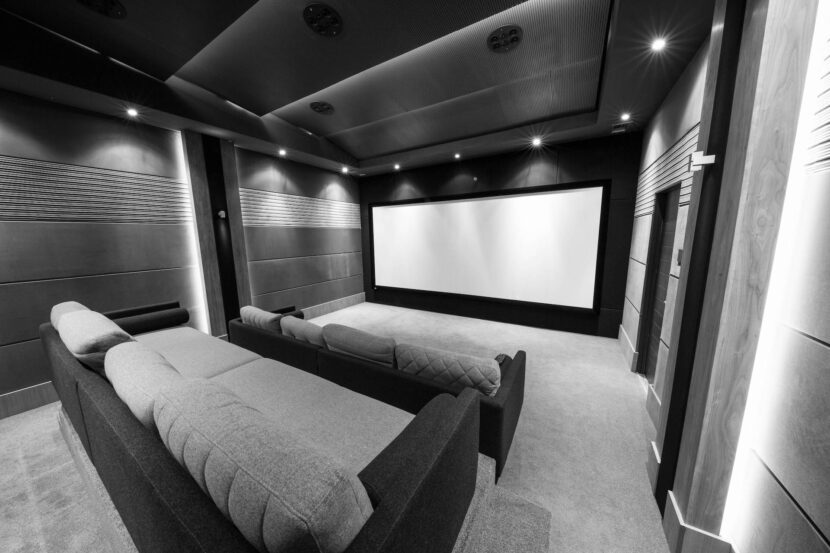
A truly great private cinema doesn’t happen by accident. And until recently, it almost hasn’t really happened in Cape Town at all.
Walk through the most expensive homes on the Atlantic Seaboard; they’re exquisite. Step inside the architecturally celebrated properties perched above Constantia; amongst the best in the world. What you’ll find, almost without exception – for the cinema rooms at least – are rooms that spent a serious budget, and delivered a mediocre result.
A ceiling-hung projector buzzing away over leather recliners. Bass that rattles the joinery. A screen surrounded by warm-toned plaster that kills every black level. Beautiful on the surface. Broken underneath.
This isn’t a budget problem. Cape Town has no shortage of clients willing to spend properly. It’s a procedural focus problem — and specifically, a problem with who gets called in, when, and what they ‘encourage’.
The finest private cinema spaces are the result of one thing: the right people in the room at the right time. That means architect, interior designer, and a dedicated cinema designer working together from concept stage. Not from fit-out stage. Not after the contractor has already poured the slab. Not as an afterthought bolted onto an interior design that was never built for the purpose.
Get the sequence wrong, and no amount of money spent on equipment will save you. Get it right, and the room disappears — leaving only the film.
Here are the five non-negotiables.
1. Space Planning Has to Happen First
Most private cinemas that disappoint were never properly planned as cinemas. They were rooms that got a projector added to some seating the architect thought would fit.
In Cape Town’s high-end residential market, where build costs per square metre are substantial and structural changes after the fact are ruinously expensive, getting this right at schematic design stage isn’t optional — it’s financial common sense.
- Seats need clearance from walls for proper bass distribution
- Ceiling heights govern screen size and whether tiered seating is even feasible
- Equipment needs a dedicated plant room — ceiling-mounted projectors belong in boardrooms, not serious cinema spaces
- Acoustic isolation can require up to 400mm of build-up per surface — walls, floors, ceilings — which fundamentally affects the structural brief
- Speaker positions are dictated by geometry and cannot be shifted to suit a joiner’s preference or an architect’s floor plan revision
Sphere Custom works at schematic stage because that’s the only point at which the right decisions can still be made without compromise.
2. Acoustics Are Non-Negotiable — and Non-Improvised
The moment a client sees foam panels stuck to walls covered in fabric, they should walk out.
Acoustic performance in a serious cinema space is engineered — not decorated. It requires proper integration with the interior design from day one, not a remedial layer applied once the build is complete.
- Fabric in front of any speaker or treatment panel must be acoustically transparent — and verified as such
- Absorption must be calibrated: carpet absorbs high frequencies aggressively; over-apply it and the room sounds dull and bass-heavy
- HVAC is the enemy of immersion — noise floors are destroyed by poorly designed air paths; cinemas should never be sited adjacent to plant rooms
- Cheap foam is ineffective and it looks exactly like what it is
Cape Town’s luxury residential builds demand finishes and materials of the highest quality. The acoustic design has to match that standard — and it has to be designed in, not applied afterwards.
3. The Room Is Part of the Image
Every surface in a cinema contributes to what you see on screen. This is not a figure of speech.
Light from the projector strikes the screen and reflects back across every surface in the room. Those reflections return to the viewer’s eye and degrade the image — washing out contrast, introducing colour casts, killing the black levels that define cinematic quality.
- The wall and ceiling zone immediately surrounding the screen — at minimum one metre in every direction, ideally more — must be dark, matte, and non-reflective. Ideally black
- The overall palette must be neutral. Cream walls and warm timber look beautiful in an architect’s render; they destroy contrast on screen
- Lighting must be directed entirely away from the screen and neutral in colour temperature — warm-toned LED coves tint the image in ways most clients never identify, but always feel
The finest residential architecture in Cape Town is built on restraint and precision. So is a properly designed cinema room. The two are entirely compatible — provided the cinema designer is briefing the interior designer from day one, not inheriting their decisions at fit-out.
4. Build It Like a Cinema — Because It Is One
A cinema is closer in construction to a recording studio or a concert hall than it is to a lounge. Treating it like the latter is the single most common reason high-budget projects underperform.
- Acoustic treatment must be structurally integrated — not retro-fitted
- Speaker mounts must be precision-engineered; how a speaker is fixed and angled is not an afterthought
- Bass energy in a properly calibrated cinema is substantial — without solid construction, panels rattle, fixtures buzz, and the room fights the system
- Every cabinet, bar unit, and joinery element must be engineered to avoid vibration transfer
In the kind of homes Sphere Custom works in across the Western Cape, the architectural detailing is exceptional. The cinema construction must be held to the same standard — or it will be the one thing that lets the entire project down.
5. Equipment Is the Last Decision — Not the First
This is where most projects go wrong before they’ve even started.
When a client opens a conversation with “we’re thinking about a Sony laser projector and a JBL Synthesis system,” the order of operations is already broken. Equipment selection is the final step in a design process, not the starting point.
The sequence is: performance targets → acoustic design → construction specification → equipment selection. Reverse it, and you’re fitting the room to the kit. That’s not design — that’s retail exploitation.
- Define measurable performance targets before a single product is specified
- Justify every equipment choice against engineering standards and room geometry
- Provide full documentation: not a quote, a specification
- Charge properly for that expertise — because the alternative costs far more
In a market where a serious private cinema installation starts at well north of $150,000, the cost of a proper design process is negligible against the cost of getting it wrong.
In Summary
The best private cinemas, – globally – the ones that genuinely rival commercial cinema performance while sitting inside architecture of the highest calibre, well, they follow a single, non-negotiable sequence:
Space planning → Acoustic design → Construction → Equipment.
Sphere Custom has been doing this in South Africa for over a decade.
If you’re at concept stage on a new build or a significant renovation, this is exactly the right moment to talk.